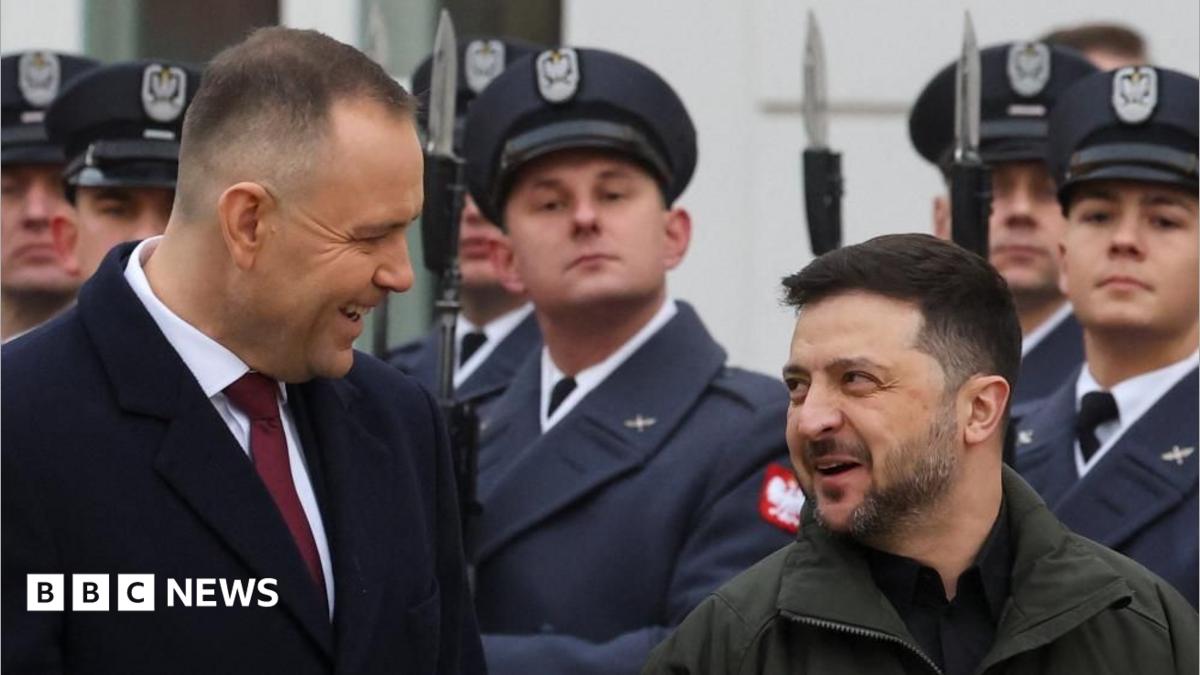
Poland’s political debate over Ukraine has intensified after President Volodymyr Zelensky signed a decree that Warsaw views as deeply offensive. The move has angered politicians across the Polish spectrum, including opposition figures and some generally pro-Ukrainian leaders, and has raised new questions about the future of bilateral relations, Poland’s support for Kyiv, and Ukraine’s path toward the European Union.
The dispute centers on the Ukrainian Insurgent Army, or UPA, a nationalist wartime group that Ukraine often portrays as a symbol of resistance and independence. Poland, however, associates the group with the Volhynia massacres, in which Warsaw says about 100,000 ethnic Poles were killed. Zelensky said he used the UPA’s name in his decree “with the aim of restoring the historical traditions of the national army,” but the decision has been widely condemned in Poland as insensitive to the memory of Polish victims.


The backlash has been particularly strong among opposition Law and Justice (PiS) politicians, some of whom are now calling for a major reassessment of relations with Kyiv. Krzysztof Bosak, leader of the far-right Confederation party, said Poland should stop funding Starlink satellite services used by Ukraine’s military and should block Ukraine’s accession to the European Union until the decree is reversed. Karol Nawrocki, who has also taken a hard line, said Zelensky’s decision showed that “Ukraine is not ready to join the European family.”
Even politicians who are usually seen as supportive of Ukraine have criticized the decree. Prime Minister Donald Tusk urged Kyiv to find a solution, warning that if it does not, “not empathy but hard business” will shape future relations between the two countries. His comments reflect growing frustration in Warsaw, where many people still feel Ukraine should show more appreciation for Poland’s role in helping millions of Ukrainians escape Russia’s full-scale invasion. Poland continues to host nearly one million Ukrainian refugees, making it one of the main havens for people displaced by the war.
The issue has also become politically sensitive because the red-and-black UPA flag is still used by some Ukrainian troops on the front line, reinforcing Polish concerns that wartime symbolism is being rehabilitated without adequate acknowledgement of past crimes. Kyiv has not formally responded to the criticism from Poland, though its foreign ministry has said it did not intend to cause offense.
The tension comes at a delicate moment for Ukraine, which depends heavily on Polish support for transit, logistics, and international backing. Zelensky’s chief of staff, Kyrylo Budanov, traveled to Warsaw last weekend after Nawrocki threatened to strip Zelensky of the Order of the White Eagle, one of Poland’s highest honors. The visit suggests that behind-the-scenes efforts are under way to prevent the row from worsening further.
For now, the dispute highlights how unresolved historical grievances continue to shape modern politics. What began as one decree has now become a broader test of trust between two neighboring countries that remain strategically linked by war, security, and Europe’s future.