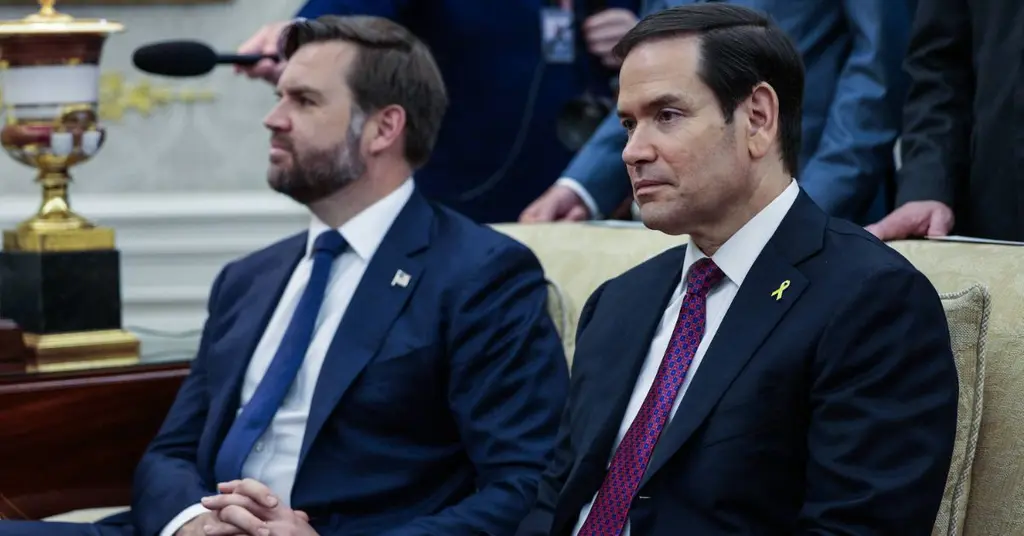
Secretary of State Marco Rubio has sharply closed the gap with Vice President J.D. Vance in early polling for the 2028 Republican presidential primary, according to a new Emerson College Polling survey. The latest results show Vance with 35.5 percent support among likely Republican primary voters, just ahead of Rubio at 34.6 percent. Florida Gov. Ron DeSantis trails far behind with 5.4 percent, followed by former South Carolina Gov. Nikki Haley at 4.6 percent. Another 15 percent of respondents said they remain undecided.
The new numbers mark a significant change from Emerson’s earlier polling. In February, Vance held a wide lead with 52 percent support, compared with Rubio’s 20 percent. In an August Emerson survey, Rubio was even further behind at 9 percent while Vance again stood at 52 percent. The latest poll suggests the Republican field has become far more competitive, even though no candidate has formally launched a campaign.

Spencer Kimball, executive director of Emerson College Polling, said the race has shifted notably since February. He said Rubio has gained strength among Republican voters over 50, where he leads Vance by a six-point margin, 41 percent to 35 percent. Vance, meanwhile, performs better among younger Republican voters under 50, leading Rubio 37 percent to 26 percent.
The survey was conducted May 24-25 among 432 likely Republican primary voters and has a credibility interval of 4.7 percentage points. While the sample remains relatively small, the results indicate a rapid movement in Republican preferences as speculation grows around the party’s next presidential contenders.
Discussion of a possible future Republican ticket has intensified in recent weeks, despite neither Vance nor Rubio having formally entered the race. Earlier in May, Vance rejected questions about whether he might one day share a ticket with Rubio after President Donald Trump described them as a possible “dream team.” Vance suggested that voters would likely view such speculation unfavorably, saying he was reluctant to discuss a political future that is still years away.
White House Communications Director Steven Cheung also dismissed the speculation, saying the administration remains focused on governing and delivering results. He said no amount of media attention over a possible Vance-Rubio matchup would distract the White House from its mission.
Political analysts say Rubio’s rise may be linked to his growing profile on foreign policy. Columbia University professor Robert Y. Shapiro said Rubio has recently overshadowed Vance on issues such as the Iran war and broader international affairs. Shapiro argued that Rubio has also appeared stronger as a national leader in recent weeks.
For now, the polling suggests that the Republican race for 2028 is no longer dominated by a single clear frontrunner. Vance still leads, but Rubio’s surge has turned what looked like a one-sided contest into an increasingly competitive early battle for the party’s next presidential nomination.