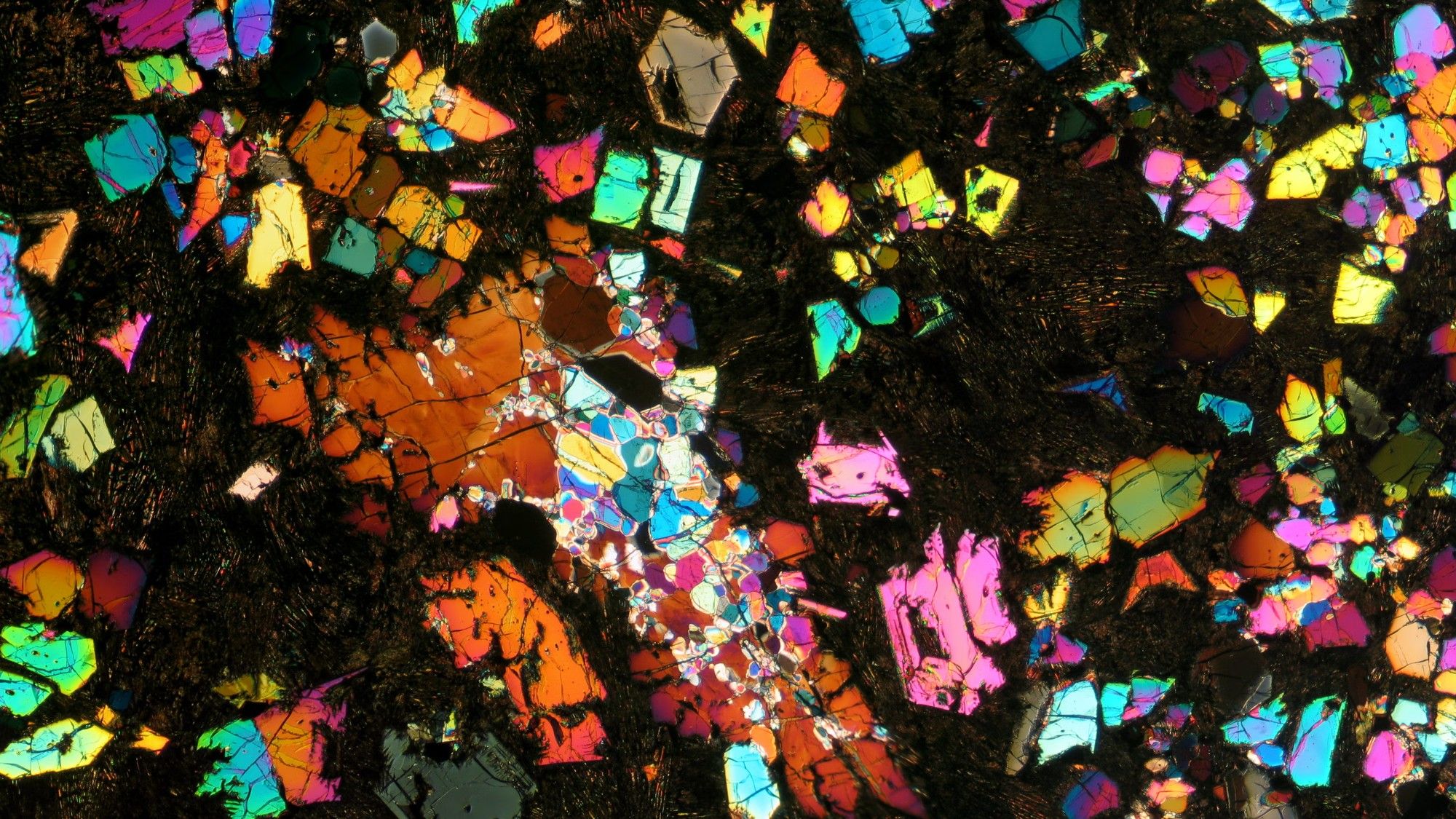
A rare meteorite found in the Sahara Desert may provide the first direct evidence of a long-lost protoplanet that existed in the early solar system and may have been nearly moon-sized. The rock, Northwest Africa 12774, was recovered in 2019 and identified as an angrite, a very rare class of ancient volcanic meteorite. Angrites formed more than 4.5 billion years ago, when the solar system was still young, and only 68 of more than 80,000 known meteorites on Earth belong to this group.
The new study says NWA 12774 preserves an unusual chemical signature that points to a much larger parent body than scientists had previously believed. Angrites are unusual because they contain very little silica, unlike Earth, Mars and most other rocky worlds. That chemistry had led researchers to think they came from a relatively small asteroid. But analysis of the meteorite’s minerals, especially aluminum-rich clinopyroxene crystals, suggests the rock formed under intense pressure of at least 17.5 kilobars, far beyond what a small asteroid could generate.

Scientists also found that the crystals retained sharp edges and chemical patterns that would likely have been erased if they had spent a long time deep inside a hot interior. This suggests the minerals formed at shallow depth, meaning the parent world had to be large enough to create extreme pressure near its surface. Based on those conditions, researchers estimate the lost body may have had a radius of more than 1,118 miles, making it comparable in size to the moon and possibly approaching Mars.
The finding indicates that some of the earliest planetary bodies in the solar system may have evolved along a different path than Earth and Mars. Study author Aaron Bell of the University of Colorado Boulder said the materials that formed the angrite parent body were fundamentally different from the ingredients of Earth and Mars, pointing to a separate route of planetary development. The researchers believe the ancient world was likely destroyed in a collision during the chaotic early period of solar system formation, scattering fragments that later became part of other rocky planets, including Earth.
The study also raises the possibility that more evidence of these vanished worlds is still sitting unnoticed in meteorite collections around the world. Bell said many meteorites have not yet been thoroughly studied, suggesting there may have been additional protoplanets that scientists have not recognized. The research was published in Earth and Planetary Science Letters.