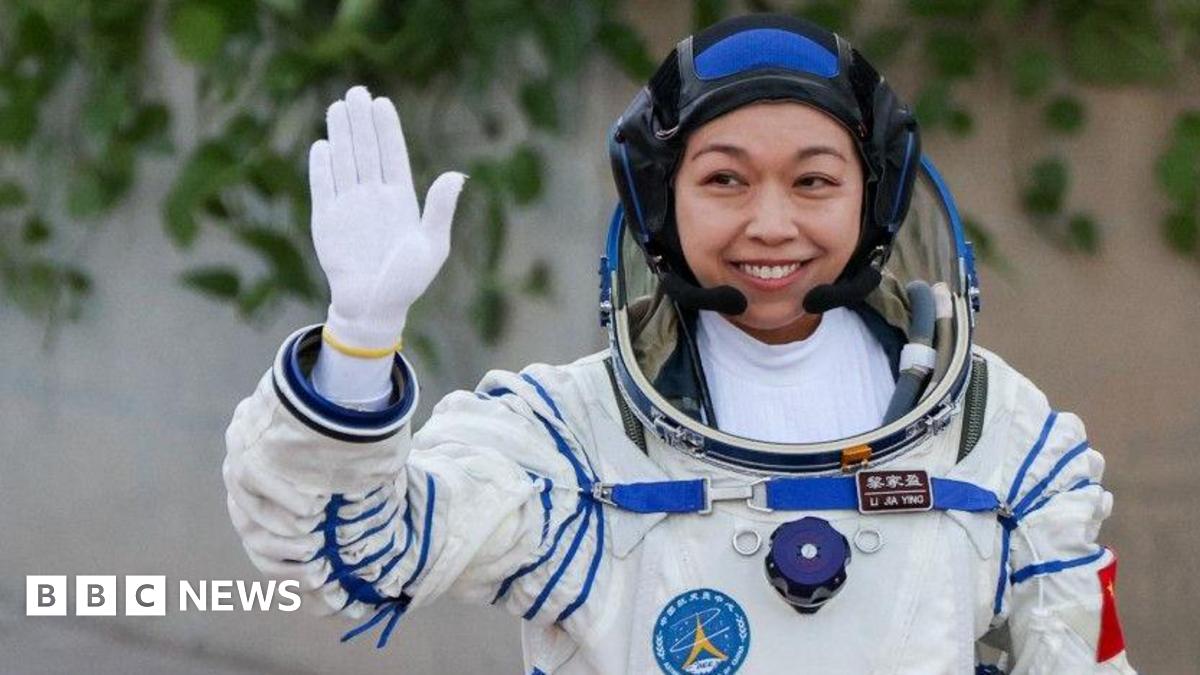
China launched a crewed Shenzhou mission from the Gobi desert on Sunday night, sending three astronauts to the Tiangong space station after a smooth lift-off on a Long March 2F rocket. The launch took place at 23:08 local time (15:08 GMT) from the north-western desert site, where large crowds gathered and waved Chinese flags as the rocket rose into the night sky. A few hours later, the spacecraft successfully docked with Tiangong, marking another milestone in China’s expanding space programme.
The mission drew particular attention because it included Li, an astronaut from Hong Kong, whose participation was described by Hong Kong Chief Executive John Lee as a “historic” moment. Her presence on the crew has been seen as symbolically important, both for Hong Kong and for China’s wider efforts to present space achievements as national achievements.


Li said she was inspired by Yang Liwei, China’s first astronaut, according to Xinhua. She described the opportunity to go to space as rare and said she wanted to take on the challenge. Before the launch, Li told CCTV that China’s achievements in space reflected national pride, saying: “How high our Chinese spacecraft flies, that’s how high we can hold our heads high.” Her remarks were widely shared in Chinese state media coverage of the mission.
The launch comes as China continues to advance its human spaceflight ambitions through the Tiangong station, which has become a central platform for long-duration missions, scientific experiments and the development of China’s independent space capabilities. The country has made major investments in its space programme over the past two decades, including crewed flights, lunar exploration and satellite technology.
Analysts told BBC Chinese that stories like Li’s, featuring successful figures from Hong Kong, may help Chinese authorities promote patriotism, particularly among young people. Such missions are often presented not only as scientific achievements but also as evidence of national strength, technological progress and unity. In that sense, Li’s participation carries significance beyond the technical success of the launch and docking.
The mission also highlights the growing visibility of Hong Kong in China’s national projects. Li’s journey to Tiangong gives Beijing a high-profile example of integration and representation, while also offering a powerful image of a Hong Kong figure taking part in one of China’s most prominent state-backed achievements. The event was framed in state media as a source of pride and inspiration, reinforcing messages of ambition, confidence and collective accomplishment.
With the successful launch and docking completed, attention now turns to the crew’s work aboard Tiangong and the broader role such missions will play in China’s future space plans.