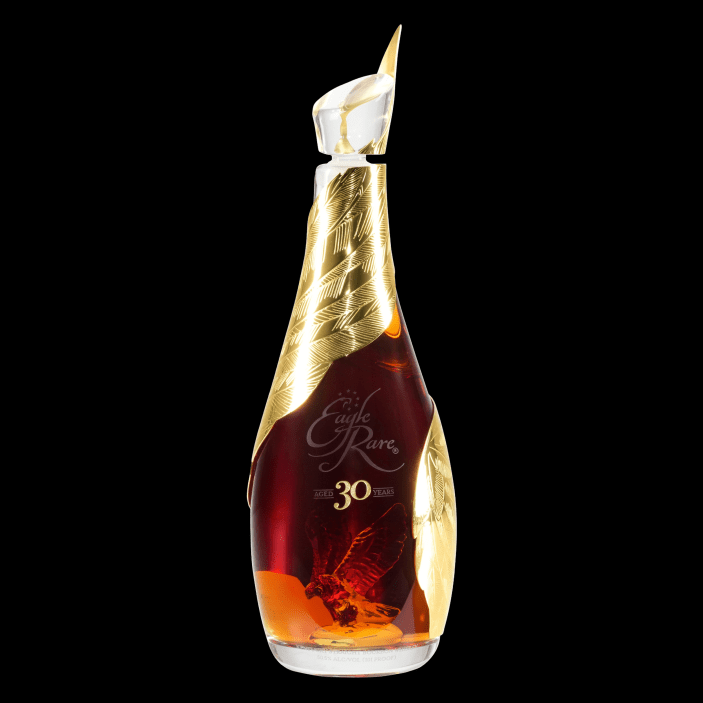
Buffalo Trace has introduced Eagle Rare 30, a 30-year-old bourbon that now holds the highest age statement ever released on a bottle from the distillery. The new expression follows Eagle Rare 25, unveiled just three years ago, and reflects Buffalo Trace’s continued experiment with extreme aging in bourbon. The whiskey was matured first in standard conditions before being transferred to the distillery’s climate-managed Warehouse P for extended aging, an approach designed to preserve quality during long maturation and reduce the harshness that often appears in very old bourbon.
The release highlights Buffalo Trace’s broader effort to test whether bourbon can benefit from the kind of ultra-aging commonly associated with Scotch, Irish whiskey, and Japanese whiskey. In those categories, prolonged maturation can create layered oak, spice, and sweetness, but bourbon can become overly dry or astringent when aged too long. Buffalo Trace says its warehouse program, developed from earlier Warehouse X experiments, is intended to push aging boundaries while maintaining balance and drinkability. Eagle Rare 30 is presented as the latest step in that pursuit.
According to the review, Eagle Rare 30 was drawn from a single consolidated barrel, and Buffalo Trace has not said how many bottles will ultimately be released. The first two bottles are being offered through Bonhams, and auction interest is already described as strong, with the sale expected to be one of the most closely watched whiskey auctions of 2026. The bottle carries an average price estimate of $12,500 and an ABV of 50.5%.
The tasting notes describe a bourbon with remarkable depth and refinement for its age. On the nose, it shows leather, chocolate-covered figs, cola nuts, cinnamon bark, vanilla pods, cardamom, toasted almonds, and black pepper. On the palate, the whiskey opens with Eagle Rare’s familiar black cherry character, followed by glacé lemon, mature oak, brown sugar, apple leather, and honey-sweetened black tea. The review emphasizes its silky texture and notes that it avoids the acrid dryness that often weakens ultra-aged bourbons.
The finish is described as long and layered, with date syrup, buckwheat honey, peppercorn, and fresh vanilla. Overall, the whiskey is portrayed as a highly polished example of what extended bourbon aging can achieve when the maturation environment is carefully controlled. Rather than tasting over-oaked or exhausted, Eagle Rare 30 is said to retain energy, sweetness, and structure despite its advanced age.
The review concludes that Eagle Rare 30 shares the anti-astringent profile seen in Eagle Rare 25 but goes further, pushing flavor deeper into oak while still remaining vibrant. It is framed as a significant entry in American whiskey and a likely contender for bourbon of the year. Buffalo Trace’s latest release reinforces Eagle Rare’s “reach higher” identity and signals that the distillery’s work in long-aged bourbon is far from finished.