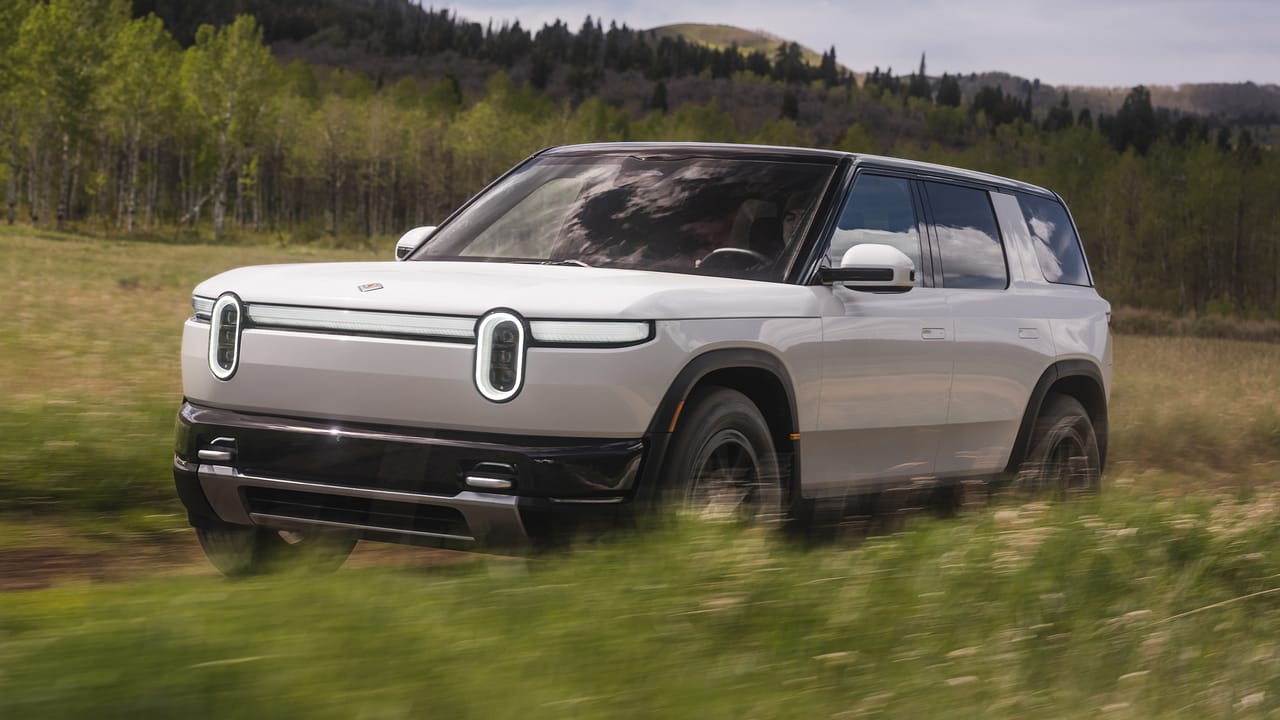
Rivian’s R2 is the company’s latest electric SUV and its most important attempt yet to reach a broader audience beyond the premium buyers who made the R1T pickup and R1S SUV stand out. Smaller and more affordable than its larger sibling, the R2 is designed to strike a balance between everyday usability and weekend adventure, while still carrying the rugged, outdoorsy character that defines the Rivian brand. At a glance, it resembles a more compact R1S, but the new model’s proportions are tighter and more practical for a wider range of drivers.
The launch lineup starts with the Performance trim, which uses dual motors and all-wheel drive to produce 656 horsepower and 609 lb ft of torque. Rivian says it can accelerate from 0 to 60 mph in 3.6 seconds and offers an EPA-estimated 330 miles of range. The Performance model is priced at $57,990 before fees. Below that sits the Premium version, which also uses dual motors and all-wheel drive but makes 450 horsepower and 537 lb ft of torque. It is expected to be slightly slower but costs less at $53,990. A more affordable Standard model is due next year, bringing a single-motor rear-wheel-drive setup with 350 horsepower, 355 lb ft of torque and 345 miles of range in long-range form for $48,490. Rivian also plans a lower-priced rear-drive version with about 275 miles of range for $44,990 next summer. All versions use an 87.9kWh usable battery pack, native NACS charging, and can add 150 miles of range in 15 minutes on compatible fast chargers.


On the road, the R2 is described as smooth, composed and easy to live with. It does not use the air suspension found in the R1 models, instead relying on a coil-spring setup with electronic dampers on the Performance trim. That more conventional hardware still delivers strong comfort and good control, with bump absorption and reduced body roll that make the SUV feel stable and confident. Its unibody construction helps it feel like a well-sorted modern utility vehicle rather than a rough, truck-like off-roader.
Off-road, the R2 remains capable enough for trail driving and tougher outdoor routes, but it is not positioned as an extreme rock-crawling machine like the R1. Its ability level is closer to vehicles such as the Ford Bronco Sport Sasquatch or Subaru Outback, making it suitable for adventurous buyers without demanding serious off-road expertise.
Technology is a major part of the R2’s identity. It includes advanced driver-assistance features aimed at eventually supporting more hands-free point-to-point driving, along with a voice assistant and AI-driven systems designed to personalize the vehicle and help manage tasks such as navigation, scheduling and service planning. Rivian says drivers can opt out of data collection, and collected data is encrypted.
Inside, the R2 features a clean, airy cabin with a 12.3-inch driver display and a large 15.3-inch central touchscreen that controls most functions. A new setup tutorial helps owners learn the system. Overall, the R2 arrives as a capable, tech-heavy and broadly appealing electric SUV, though its depth of features may require a learning curve for some buyers.