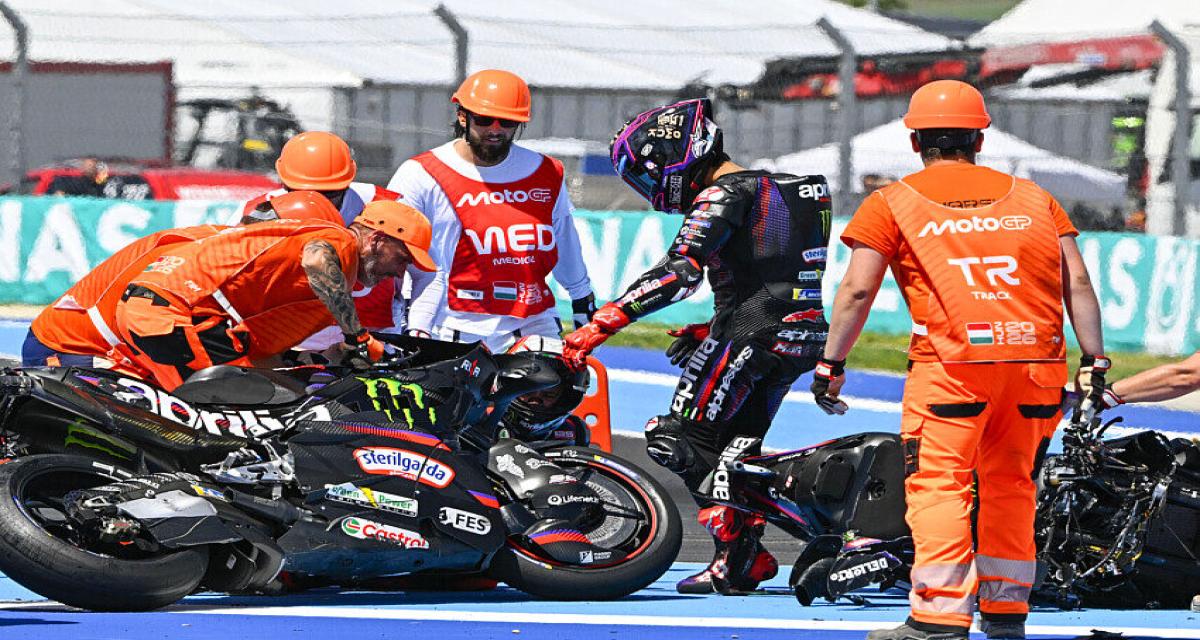
Jorge Martin has come under heavy criticism after the dramatic first-corner crash at the Hungarian Grand Prix, where Marco Bezzecchi, Raul Fernandez and Fermin Aldeguer were all eliminated immediately after the start. The Spanish world champion also received a double Long Lap penalty for his role in the incident, but not everyone agrees that he should be blamed alone. Iker Lecuona has now spoken out in Martin’s defence, arguing that the accident should be assessed in the context of the Balaton Park circuit and its track conditions rather than only as a mistake by one rider.
Lecuona believes the layout of the Hungarian venue and the nature of the asphalt played a major part in what happened at the opening corner. In his view, the crash would likely not have occurred on a more conventional track with a more standard surface. He said Martin did not make a strong start and was placed in a difficult braking situation, but insisted that this does not automatically make him the sole cause of the pile-up. According to Lecuona, Martin ended up too far to the inside of the racing line and entered a particularly critical section of the circuit at the worst possible moment.


The Spanish rider went further, saying Martin’s error did not amount to a serious fault and should not attract the level of criticism he has received. He pointed instead to the extreme sensitivity of the motorcycles under braking at Balaton Park, a problem that reportedly affected many riders throughout the weekend. In his explanation, the combination of tyres and asphalt made the front of the bike highly unstable, making overtakes in that area extremely difficult and leaving very little margin for error. He added that front-end locking under braking was a recurring issue, happening almost every lap, which shows how demanding the circuit conditions were for the entire field.
Lecuona’s comments shift attention away from an individual assessment of Martin’s mistake and toward broader questions about safety and circuit design. Rather than treating the Hungarian Grand Prix crash as the result of one rider’s decision alone, he suggests it was the product of a specific track, a difficult surface and an especially sensitive braking zone. The incident has therefore reopened debate about Balaton Park and whether its characteristics contributed to the chaos seen at the start. For Martin, the criticism may continue, but Lecuona’s intervention offers a strong reminder that racing incidents are often shaped by more than one factor.