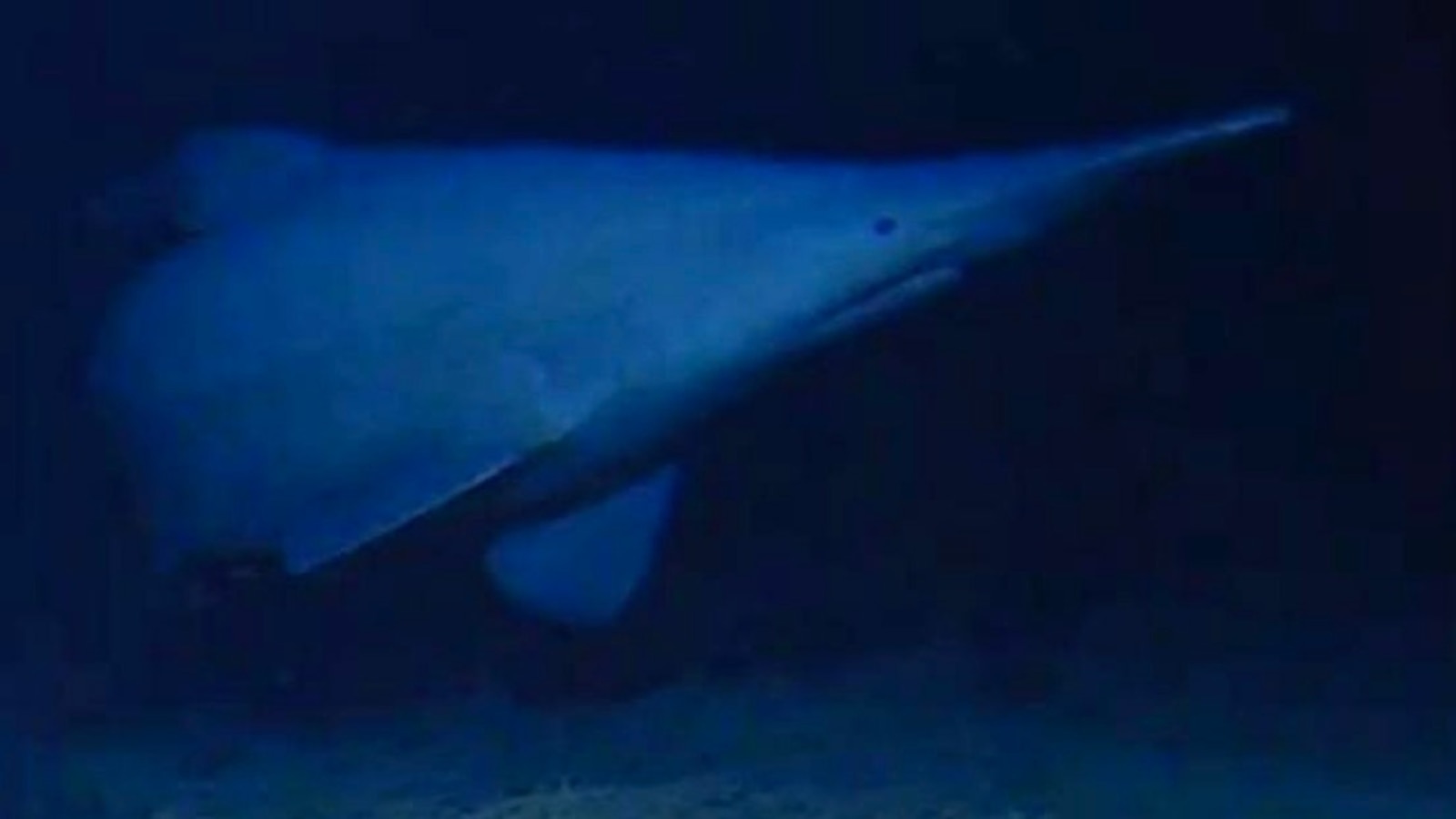
Scientists have confirmed the first peer-reviewed video footage of a live goblin shark in its natural habitat, a rare and ancient deep-sea species often called a “living fossil.” The shark, Mitsukurina owstoni, is the only surviving member of a lineage that dates back about 125 million years. Known for its elongated, horn-like snout and highly specialized jaws that can shoot outward to seize prey, the goblin shark is one of the ocean’s most unusual predators. Its rostrum contains Ampullae of Lorenzini, sensory organs that help it detect electrical signals from squid, fish and crustaceans in the dark depths where it lives. Adults can reach about 10 to 12 feet and are typically pale white or pinkish, giving them an almost ghostly appearance.
The study, published in the Journal of Fish Biology, confirmed two separate wild sightings. The first occurred in 2019 when a remotely operated vehicle from the research vessel EV Nautilus captured video of a goblin shark near an unnamed seamount close to Jarvis Island, a U.S. territory in the central Pacific. The shark was filmed about three-quarters of a mile below the surface before the vehicle’s lights and noise caused it to swim away. At the time, researchers on board did not realize the significance of the sighting.
/https://i.s3.glbimg.com/v1/AUTH_da025474c0c44edd99332dddb09cabe8/internal_photos/bs/2026/v/L/GprqdrT3OBQGzE06jYkQ/98375352-ec-rio-de-janeiro-rj-30-03-2022-greve-dos-peritos-do-inss-servidora-do-inss-e-os-paci-5-.jpg "Relaxing BPC Oversight Will Exact a High Cost on the Country")

A second confirmed observation came in 2024, when baited camera footage recorded another goblin shark along the slope of the Tonga Trench, about 1,250 miles southwest of Jarvis Island. Scientists say this is the first confirmed video of the species in a trench slope environment and suggests goblin sharks may use a wider range of deep-sea habitats than previously known.
Researchers say the discoveries significantly expand the known geographic range of the species, which has now been documented in the Pacific, Atlantic and Indian oceans. The sightings also highlight the importance of seamounts and trench slopes as biodiversity hotspots in the deep sea. Because goblin sharks are so rarely encountered, most knowledge about them has come from fisheries bycatch or specimens brought closer to the surface.
Experts say the confirmed footage is important not only for understanding goblin shark biology, but also for deep-sea conservation. As fishing activity moves deeper and interest in seafloor mining grows, scientists say documenting rare species and their habitats is essential for protecting ocean biodiversity. Despite the breakthrough, much remains unknown about the goblin shark’s behavior, life cycle, and population status, making each new sighting valuable for future research.