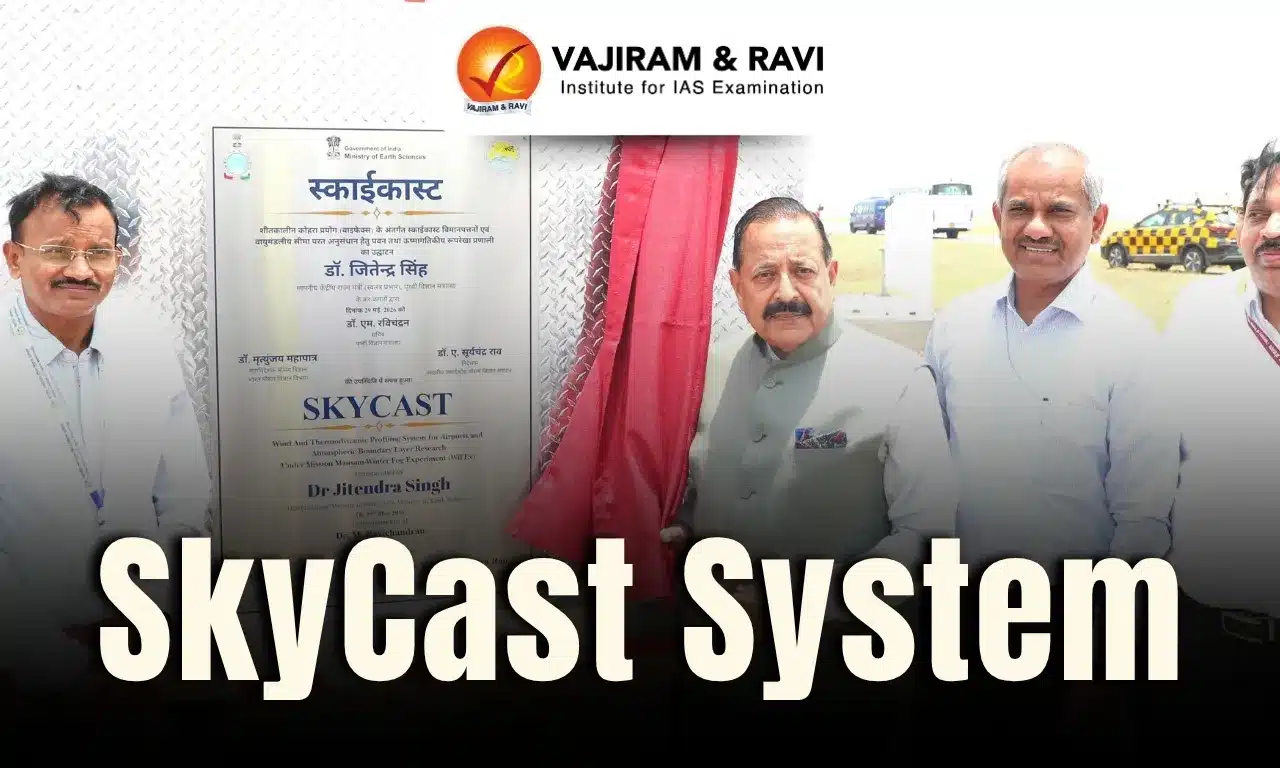
India has inaugurated its first SkyCast system at Indira Gandhi International Airport in New Delhi, marking a major step in aviation weather monitoring. The system was launched by the Union Minister of Earth Sciences and is designed to provide real-time, high-resolution weather intelligence for flight operations, especially in fog-prone and low-visibility conditions.
SkyCast is an advanced integrated aviation weather monitoring system developed under Mission Mausam. Its scientific basis comes from the Winter Fog Experiment (WiFEX), a joint initiative of the Indian Institute of Tropical Meteorology (IITM) and the India Meteorological Department (IMD) under the Ministry of Earth Sciences. The experiment began at IGI Airport in 2015 and helped shape the development of the new system. With this deployment, India has become the 19th country in the world to install an advanced integrated aviation weather monitoring system.

The SkyCast system combines multiple atmospheric remote sensing technologies into one platform. Its core component is the Radar Wind Profiler, which measures wind speed, wind direction, turbulence, vertical velocity and boundary-layer dynamics. These measurements are important for understanding rapidly changing weather conditions that affect takeoff, landing and flight safety.
Another important component is the Ground-based Fog Aerosol Spectrometer, or GFAS. This instrument provides detailed information about fog droplets, aerosols and the interaction between fog and airborne particles. Such data helps improve the understanding of fog formation and the atmospheric processes that influence visibility around airports.
The system also includes a CL61 Lidar-based Ceilometer, which monitors the vertical structure of fog and visibility conditions in real time. By tracking fog layers and atmospheric changes, SkyCast can better assess how weather may impact aviation operations.
SkyCast brings together measurements of fog, aerosols, turbulence, moisture, visibility and other atmospheric conditions into a single aviation weather intelligence framework. It can assess conditions from the surface up to nearly 10 kilometres altitude and generate key meteorological parameters such as wind shear, turbulence, fog formation indicators and icing potential.
The significance of the system lies in its ability to improve flight safety and operational efficiency. By giving pilots and airport operators real-time weather intelligence, SkyCast can help reduce flight delays, diversions and cancellations caused by fog and turbulence. It also supports advanced forecasting models and AI-enabled decision support systems.
Beyond aviation, the system may contribute to urban weather forecasting, pollution management, transport advisories and disaster preparedness efforts. Its integrated approach represents a major technological upgrade in India’s weather monitoring infrastructure and reflects the growing use of science-based tools to improve public safety and transport reliability.


