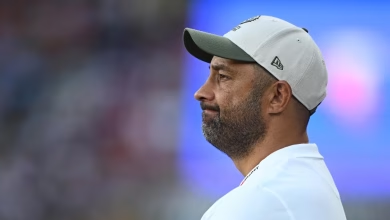
Roberto Martinez Explains Why Portugal Still Need Cristiano Ronaldo as Diogo Jota Emerges as Their World Cup ‘Light’


Portugal’s national football team is being shaped by history, structure and a uniquely outward-looking culture as it prepares for the World Cup. At the Portuguese Football Federation headquarters, an exhibition of Eusebio memorabilia and footage from the 1966 World Cup underscores how deeply that squad still resonates. Roberto Martinez, Portugal’s coach for the past three and a half years, says the “Os Magricos” team remains a source of national pride and a reminder of the values he believes the modern side should carry forward.
Martinez has immersed himself in Portuguese football culture and history since taking the job, even relocating his family to Portugal. He argues that the country’s football identity is tied to its maritime heritage: a willingness to travel, adapt and learn languages. That openness, he says, is reflected in the national team, where many players are used to working abroad and communicating in multiple languages. It is also mirrored in Portugal’s long-term football success, especially considering its relatively small population.
Portugal’s modern rise, Martinez says, has been driven by two main forces: elite coaching education and a strong youth-development pipeline. He points to the influence of university-based tactical thinking, especially the work of Vitor Frade at the University of Porto, whose ideas helped shape a generation of Portuguese coaches, including Jose Mourinho. Just as important, Martinez says, is the pathway for young players, who typically move through under-19 football, European youth competitions, B teams and senior squads in a gradual process that prepares them for first-team football earlier and more effectively than in many other countries.
That system has produced a steady stream of players who move abroad early and thrive at the highest level. Martinez cites examples such as Bernardo Silva and Vitinha, while noting how Portugal’s influence extends beyond its domestic league. Several Portuguese players were central to Paris Saint-Germain’s Champions League campaign, reinforcing the idea that Portugal consistently punches above its weight in world football.
Martinez also says the current squad is one of exceptional quality and leadership. Players such as Bruno Fernandes, Bernardo Silva, Ruben Dias and goalkeeper Diogo Costa bring experience and authority from top clubs across Europe. Fernandes, in particular, has earned praise for his consistency and creative output, while Bernardo’s intelligence and versatility make him a crucial tactical weapon.
The team’s journey has also been marked by grief, especially the death of Diogo Jota in a car accident last year. Martinez describes Jota as a source of inspiration and a symbol of the team’s mentality and resilience. He says the squad has used Jota’s memory as motivation during difficult moments.
At the center of Portugal’s present and future remains Cristiano Ronaldo. Now 41, he continues to be a defining figure for the national team, with Martinez insisting his goals, movement and professionalism still make him a major threat. Ronaldo is set to play in a record sixth World Cup, and Martinez says his influence cannot be replaced. Yet the coach believes Portugal’s strength lies not in one individual, but in a deep, adaptable system capable of competing for major honors.