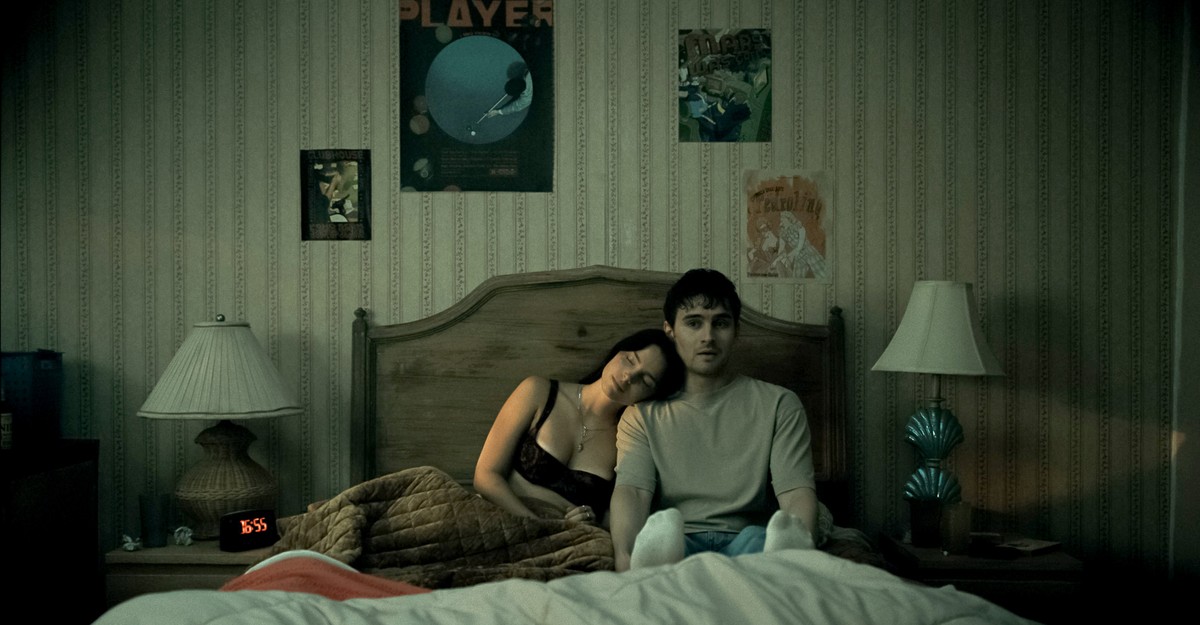
The horror film Obsession, directed by Curry Barker in his feature debut, turns a familiar romantic fear into a nightmare about desire, avoidance, and the consequences of refusing to be vulnerable. The story follows Bear, a young record-store employee who has a crush on his co-worker Nikki but cannot bring himself to confess it. Even when Nikki directly asks whether he likes her, Bear freezes. Instead of facing possible rejection, he uses a magical “One Wish Willow” charm to make Nikki love him more than anything else in the world.
What follows is a disturbing transformation. Nikki shifts from an independent, easygoing young woman into someone dangerously fixated on Bear. Her love becomes obsessive and destructive, stripping away her sense of self. She traps him, violates his privacy, and behaves in ways that make their relationship a living nightmare. The film uses this extreme scenario to explore the panic that can come from social anxiety, emotional avoidance, and fear of confrontation.

Rather than focusing mainly on domestic abuse, Obsession is presented as a story about Gen Z emotional paralysis. It reflects the way many young people experience dating, friendship, and conflict in an era shaped by social media, instant communication, and constant self-consciousness. Small acts of honesty, like admitting feelings or addressing tension, can feel overwhelming. The film suggests that some people would rather seek a quick fix than risk an uncomfortable conversation, even if that shortcut leads to disaster.
Barker builds the tension around this idea of avoidance. Bear is shown rehearsing how he might confess his feelings, worried about every possible outcome. But when the moment comes, he says nothing. His silence and the wish that follows create the central horror of the film: instead of accepting uncertainty, he tries to erase it. In doing so, he loses control of the situation and turns his own life into something terrifying.
The movie also argues that honesty is not necessarily safe. A key scene involves another co-worker, Sarah, who is about to tell Bear that she likes him. Before she can speak, Nikki appears and kills her in a violent outburst. Moments like this underline the film’s nihilistic edge and its understanding of how dangerous romantic uncertainty can feel to young people.
Despite its dark premise, Obsession has connected strongly with audiences. In just three weeks, it became a breakout success, earning more than $100 million on a budget of less than $1 million. Viewers have debated online about who the real villain is, whether Nikki is truly possessed, and what the magical object’s rules actually are. The film invites interpretation as both supernatural horror and psychological allegory.
Barker’s generation shows up throughout the movie, from internet-driven references to his YouTube background and the use of a TikTok-famous song over the credits. Those details give the film a distinct digital-age identity. At its core, Obsession captures a painful truth: for many young people, telling someone how you feel may seem more frightening than almost anything else.