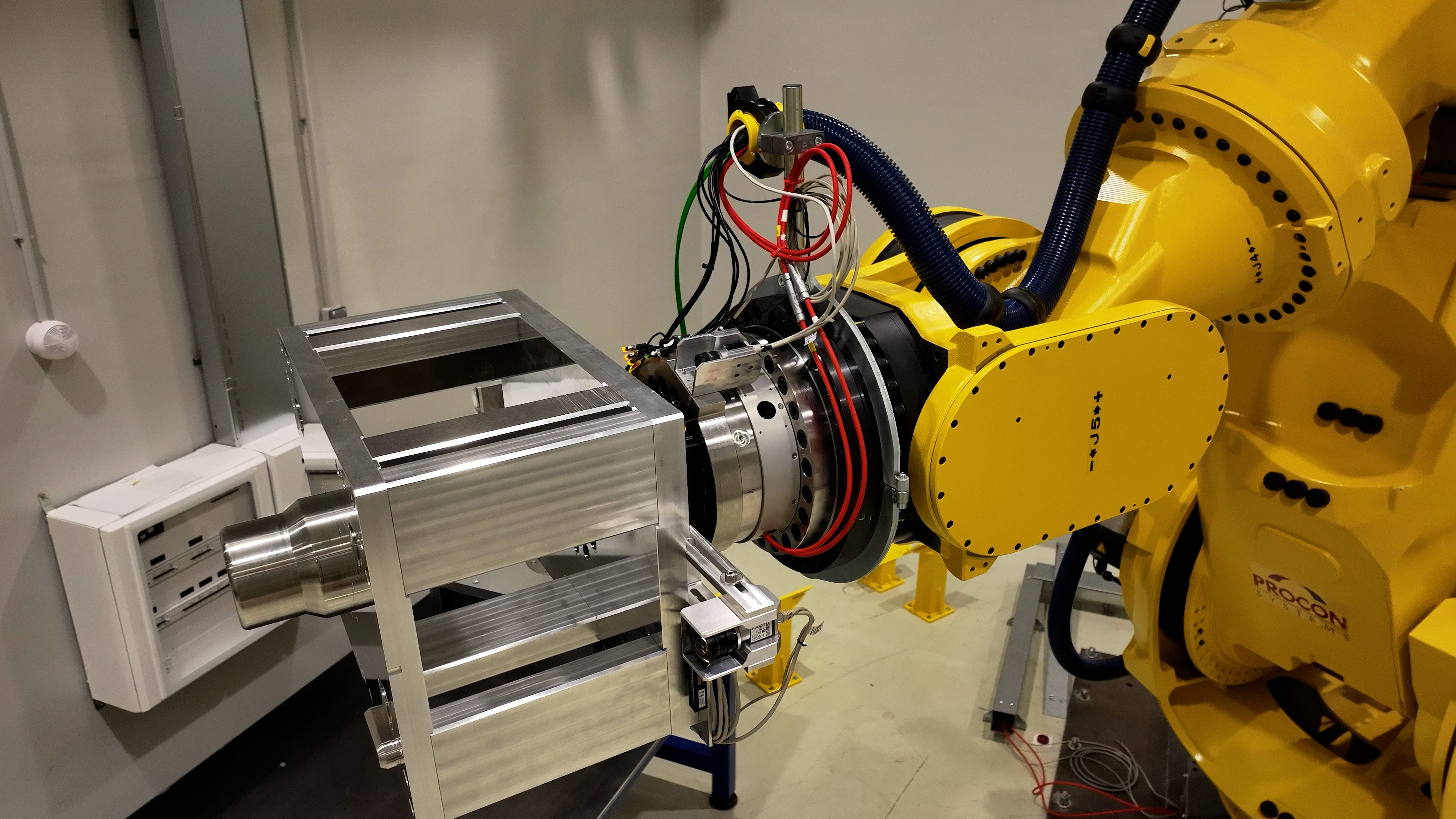
ITER is developing advanced robotics to handle the extreme demands of assembling and maintaining fusion reactor components, where parts are too large, heavy, and precisely positioned for conventional industrial machines. Some blanket manifolds reach 7.5 metres in height, blanket shield blocks can weigh as much as 4 tonnes, and divertor cassettes can weigh up to 9 tonnes. These components must be moved through narrow access points, transported around the vessel, and installed with exceptional accuracy inside a crowded environment filled with structures, cooling systems, and plasma-facing parts.
The robotics being created for these tasks are intended not only for assembly, but also to support future maintenance work. ITER and its industrial partners are building heavy-duty systems specifically designed for fusion environments, many of which have no equivalent on the commercial market. Among them is the blanket assembly transporter, a long-reach robotic arm used to install shield blocks and first-wall components inside the vessel. ITER is also developing divertor assembly systems, remotely operated handling tools, and modular staging platforms that allow workers to operate safely alongside robots during assembly.

A major challenge is giving robots capabilities closer to human perception. In addition to strength and reach, operators need machines that can “see” and “feel” with high precision. To solve this, ITER is working closely with universities, startups, and specialist industrial suppliers to adapt existing technologies and, where necessary, invent new ones for fusion applications.
Machine vision is playing a central role in improving robotic accuracy. Vision systems originally developed in academic research are now being adapted for ITER’s remote-handling operations. The goal is to help operators compensate for the way large robotic arms bend under heavy loads. Once multi-tonne components are attached, the robot’s real position can differ from its expected position. Cameras and optical reference markers, including laser-etched fiducial markers on stainless steel surfaces, allow the system to correct those deviations and align components precisely. Tests have shown that this approach can achieve positioning accuracy of about 0.06 millimetres, which is finer than the width of a human hair.
ITER is also adding tactile sensing to its robots. Working with measurement technology company HBK, engineers are developing force-torque sensors that let robotic systems detect contact forces while handling shield blocks and first-wall components. This gives the robot a sense of touch, helping it recognize when a component makes contact, avoid damaging collisions, and adjust movement when the arm flexes under load. The robot behaves more like a human operator, but with the strength and endurance needed for fusion work.
Together, these developments are laying the foundation for the next generation of robotic systems in fusion energy, where precision, safety, and adaptability are essential.