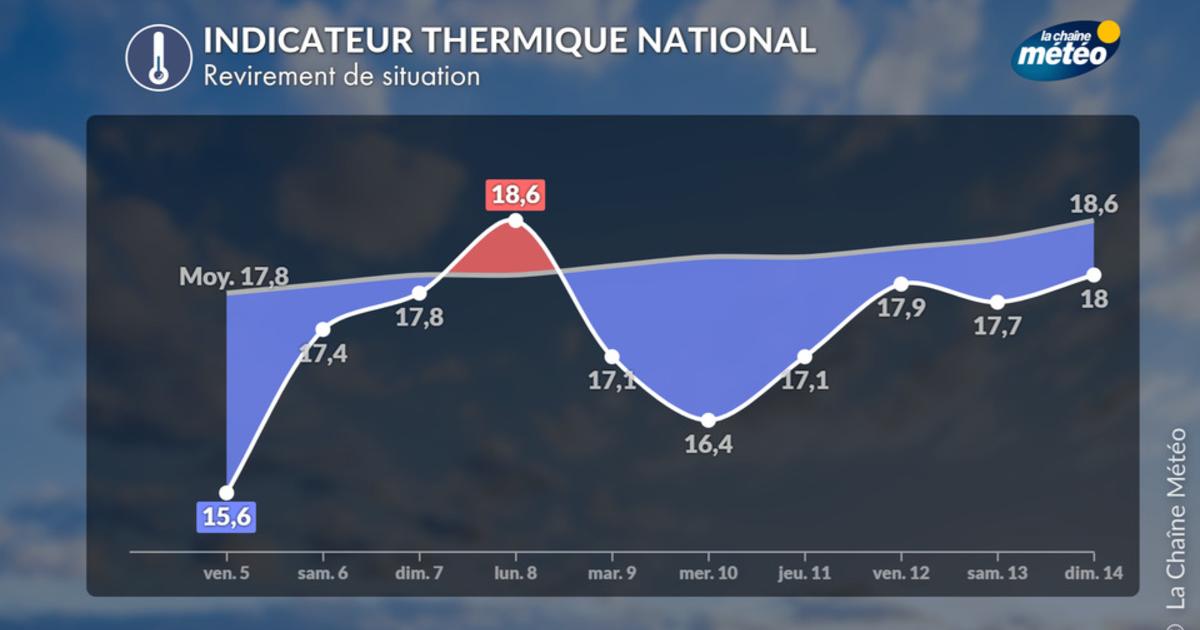
Temperatures are expected to rise again in France next week, but the chance of a widespread heat wave across the entire country now looks much lower. Current weather models point instead to a more limited warm spell, with the strongest heat concentrated in the south, while the north is likely to remain under ocean influence and experience cooler, more unsettled conditions.
High pressure is expected to return gradually over western Europe, but its center should remain positioned away from France, closer to the Iberian Peninsula and the western Mediterranean. That setup would place France on the northwestern edge of the anticyclone rather than directly beneath it. This is a key difference from the exceptional late-May heat wave, when the country was located under the core of the heat dome. As a result, Atlantic air should continue to affect part of France and prevent temperatures from rising uniformly nationwide.

A sharp temperature contrast is forecast between the northwest and southeast of the country. Along the Channel coast and in the northwest, marine winds should keep conditions relatively cool, with frequent cloud cover and occasional light drizzle or brief rain. Temperatures there may stay below 20°C, slightly under seasonal averages. By contrast, Mediterranean and southeastern regions are expected to benefit more clearly from the high-pressure system, with sunnier skies and rising temperatures.
The strongest heat is likely to focus around the Mediterranean region, especially across Languedoc, Provence and the Rhône Valley. In inland areas, daytime highs could regularly exceed 30°C, with local peaks of 32°C to 34°C in the warmest spots. While those values would feel summery for mid-June, they remain far below the exceptional temperatures recorded during the late-May event. Farther north, the oceanic flow should limit the warming, keeping temperatures closer to 20°C to 22°C.
For now, forecasters see no clear sign of a new national heat wave. Temperatures may rise above normal in parts of the country, especially in the south, but the lack of sustained heat in the north and west makes an extreme, countrywide event unlikely. The most probable scenario is therefore a split France: a hot, summerlike south and a more moderate northwest under Atlantic influence.
Uncertainty remains at this range, and the pattern could still change. If the anticyclone shifts slightly northward, the heat could spread farther across the country. Even so, the latest trends favor a more ordinary early-summer warm spell in southeastern France rather than another generalized heat wave. The second half of June will need close monitoring, but the most severe scenarios now appear much less likely than they did only a few days ago.