In mid-April 2026, Super Typhoon Sinlaku swept across the North Pacific and brought heavy rain and flooding to the Mariana Islands. The storm reached “violent typhoon” strength, the highest category used by the Japan Meteorological Agency and roughly comparable to a Category 5 hurricane on the Saffir-Simpson scale. Meteorologists noted that such an intense cyclone so early in the year was unusual for the region.
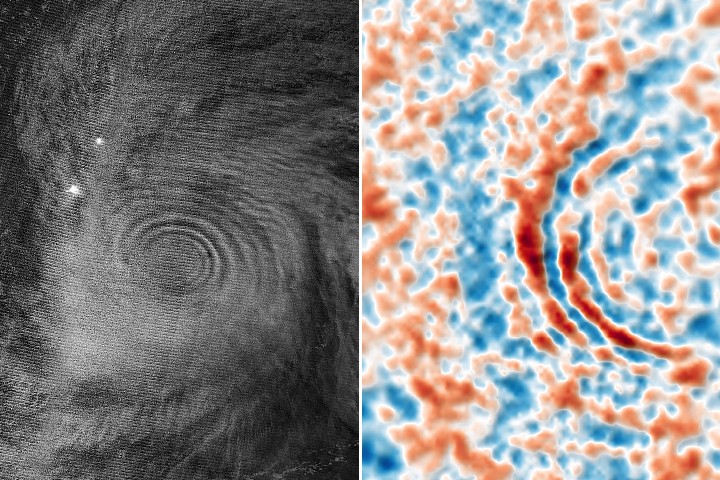
As Sinlaku rapidly intensified over open water, satellites detected not only the storm’s surface impacts but also its influence higher in the atmosphere. A nighttime image from NOAA-20’s VIIRS instrument captured atmospheric gravity waves spreading outward from the typhoon in the mesosphere. These waves, similar to ripples on a pond, became visible through airglow, a faint light emitted when atoms and molecules release energy after being excited by sunlight during the day.

Scientists say the storm’s intense convection and latent heat release near the eyewall likely fueled towering cumulonimbus clouds, or “hot towers,” that sent wave energy from the troposphere into the stratosphere and mesosphere. Prior research has shown that gravity waves often appear when tropical cyclones are strengthening. In Sinlaku’s case, the storm intensified from Category 2 to Category 5 in the 24 hours before the image was taken.
Joan Alexander, a senior research scientist at NorthWest Research Associates, said the observations showed waves moving radially and upward in a cone-like pattern. She said the nearly complete rings seen in the mesospheric airglow were notable because upper-atmosphere winds often weaken such waves before they reach those heights. In April 2026, relatively light stratospheric winds at Sinlaku’s latitude may have allowed the waves to persist. Low moonlight also helped the satellite detect the phenomenon more clearly; the Moon was about 25% illuminated on April 12, allowing some reflected light from clouds but not enough to overpower the airglow signal.
The typhoon’s gravity waves were also captured lower in the atmosphere by NASA’s AIRS instrument aboard the Aqua satellite. Those infrared observations showed rippling thermal patterns in the stratosphere on April 13 and again on April 14, indicating that Sinlaku continued to affect atmospheric dynamics after its most intense phase.
Researchers say studying these waves has practical value beyond scientific interest. Gravity waves may help scientists monitor whether a storm is intensifying, especially over the open ocean where direct observations are limited. A suitable geostationary satellite sensor could potentially track tropical cyclone evolution through these patterns.
Scientists also emphasize that stratospheric processes matter for weather prediction. Tropical cyclones can strongly influence stratospheric winds and may affect longer-range forecasts, including winter weather patterns in the Northern Hemisphere. The waves can also extend into space weather, where they may trigger traveling ionospheric disturbances or plasma bubbles that interfere with satellite navigation, radio signals, and communications.