Philippe Jordan and the Paris Opera Present Berlioz’s Requiem in a Fifth Republic-Inspired Production

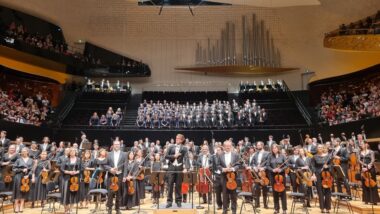
In May 2026 at the Philharmonie de Paris, Philippe Jordan led the Orchestra and Chorus of the Opéra national de Paris in a striking performance of Berlioz’s Requiem, in a setting that gave the evening a strong ceremonial and institutional feel. The concert was attended by Culture Minister Catherine Pégard, filmed, and broadcast live on France Musique and on the Opéra de Paris platform, reinforcing the sense that this was not just a major musical event but also a kind of public celebration of one of France’s long underappreciated composers.
The performance itself was marked by energy, ambition, and a distinctly French sense of grandeur. Berlioz’s Requiem, originally commissioned in 1837 under Louis-Philippe, was presented as a work rooted in revolution, spectacle, and mass effect. Jordan’s conducting favored brisk tempos and momentum, moving decisively through the opening Kyrie and pushing the music toward intensity in the great dramatic climaxes, especially in the Rex Tremendae and Offertoire. At moments of reflection, he allowed the score to breathe more, but the overall impression was one of drive rather than solemnity.


The Chorus of the Opéra national de Paris was praised for its impact, especially in the male sections, where the basses delivered a powerful, resonant foundation. The women’s chorus was noted for its discipline and stylistic accuracy, even if it was less theatrical. The performance also benefited from Berlioz’s famous spatial effects: the brass were placed in four groups across the stage and side balconies, creating striking stereophonic exchanges, while a large contingent of 10 timbalists produced a physical, almost visceral impact in the hall without becoming distorted.
Among the work’s most memorable passages, the Dies Irae and the Sanctus stood out as the evening’s high points. The brass deployment in the Dies Irae was described as especially effective, with sound traveling across the hall in dramatic waves. In the Sanctus, however, tenor Pene Pati’s entrance from an elevated side balcony did not fully achieve the intended ethereal effect. The idea was to suggest a voice descending from heaven, but in practice his singing was too faint and poorly projected toward the audience. Though the audio-visual broadcast likely handled it well, the live acoustic result was disappointing, and the problem could not be corrected in the moment.
Even with that weak point, the concert was judged a strong and compelling French reading of Berlioz’s Requiem: bold, colorful, and full of conviction. It emphasized risk-taking, orchestral brilliance, and scale, offering a powerful reminder of Berlioz’s singular place in French music.