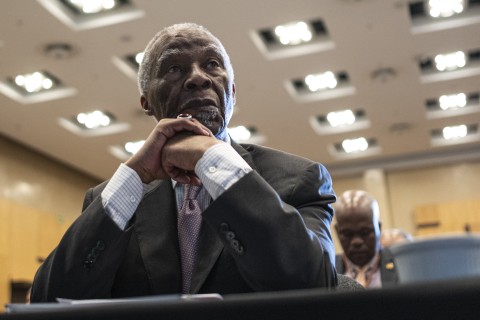
Former president Thabo Mbeki has accused apartheid-era intelligence networks of still having a strong presence within the ANC, saying the party remains vulnerable to internal sabotage more than three decades into democracy. He made the remarks in Cape Town during a town hall discussion with high school pupils and university students, where he answered questions about South Africa’s current political and social challenges. The event formed part of the 16th Thabo Mbeki Africa Day lecture, which carried the theme “Rebuilding African Unity In an Age of Fragmentation.”
During the question-and-answer session, Mbeki reflected on the ANC’s post-1994 struggles and suggested that some of the party’s setbacks were not simply the result of policy failures or political weakness, but of deliberate efforts by counter-revolutionary forces working against the democratic project. He said the ANC had tried to identify and remove harmful elements within its ranks, but acknowledged that some had never been found. His comments reignited debate about the extent to which South Africa’s liberation movement was infiltrated during and after apartheid, and whether such influences still shape political outcomes today.


Mbeki also addressed the issue of undocumented migrants in South Africa, taking a more measured stance than the rhetoric often heard in public debates. He questioned why some South Africans protest against migrants, arguing that the country’s broader problems should not be blamed on foreign nationals. His comments come amid growing tensions in parts of the country over immigration, service delivery, unemployment and access to public resources.
Outside the lecture venue, a placard demonstration was held on the steps of St George’s Cathedral in support of African migrants who, activists say, have faced threats and exclusion from essential services including hospitals, clinics and schools. The protest highlighted concerns about xenophobia and the treatment of vulnerable migrant communities in South Africa.
Wendy Pekeur of the Ubuntu Rural Women and Youth movement said poverty in South Africa should not be blamed on migrants. She argued that the root cause is a capitalist system that prioritises profit over people, leaving many communities without adequate jobs, services or economic security. Her remarks echoed broader activist criticism that public anger is often directed at migrants instead of structural inequality and economic policy failures.
The gathering placed political history, present-day governance concerns and social tensions in sharp focus, with Mbeki using the platform to revisit unresolved issues inside the ANC while urging a wider understanding of migration and inequality in South Africa.