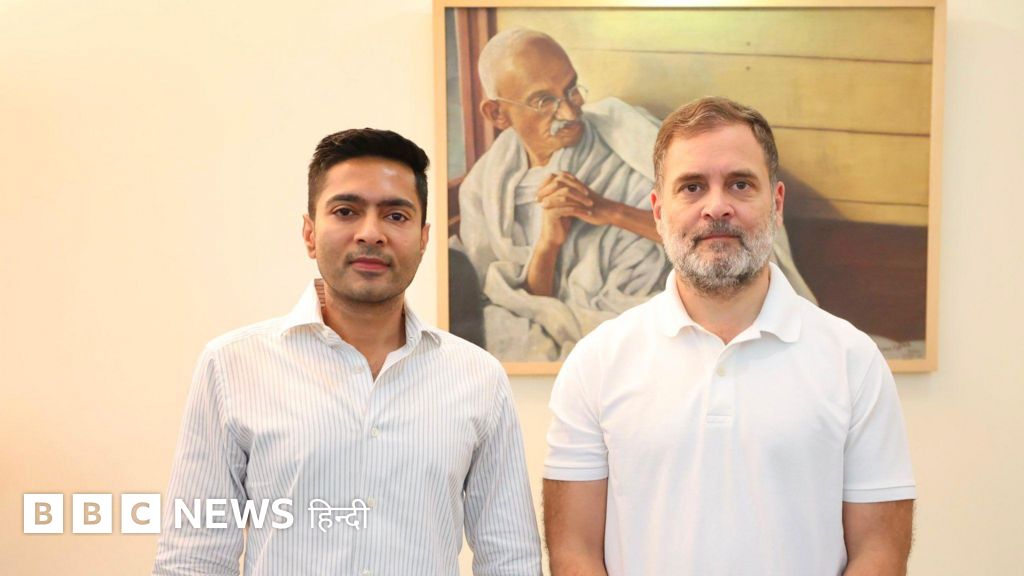
Political speculation is intensifying in West Bengal after a series of high-profile meetings between Trinamool Congress (TMC) and Congress leaders, even as both parties deny any talk of a merger. TMC chief Mamata Banerjee met Congress leader Sonia Gandhi, while TMC general secretary Abhishek Banerjee met Lok Sabha opposition leader Rahul Gandhi. The meetings quickly triggered reports in sections of the Indian media suggesting that TMC could merge with Congress, but Congress leader Jairam Ramesh rejected those claims and said the meeting between Sonia Gandhi and Mamata Banerjee was held in a cordial atmosphere. He added that the two leaders have had long-standing personal and political ties, and that their conversation also covered private matters. TMC MP Kirti Azad said he could not comment on merger rumors and said such matters could only be clarified by the party’s top leadership.
The speculation comes at a time when TMC is facing visible internal strain in West Bengal. Several legislators and parliamentarians are said to have distanced themselves from the party, and a rebel faction in the state assembly has reportedly chosen its own leader of the opposition. Claims are circulating that 20 of TMC’s 28 Lok Sabha MPs have turned rebellious, while some Rajya Sabha members have also resigned from the party and Parliament. Against this backdrop, commentators are debating whether TMC and Congress could join forces, and what that would mean for the state’s already fragmented opposition.

Congress leader Adhir Ranjan Chowdhury said he had no knowledge of any merger proposal, but suggested that TMC’s political tone has changed after recent setbacks. He remarked that the party appears divided and that senior leaders seem to be moving in different directions. His comments reflect broader uncertainty within Bengal’s opposition space, where alliances have shifted repeatedly over the past decade.
Analysts and journalists are also split over the idea. Some argue that a TMC-Congress merger could help both parties. It could give Congress access to TMC’s larger vote base and help TMC expand its role in national politics, especially on issues such as democratic backsliding. Others say the move would burden Congress with Mamata Banerjee’s declining popularity and her reputation as a combative, hard-to-manage leader. Critics argue that TMC has often weakened its allies rather than strengthening them, and that Congress should instead rebuild independently.
The article also traces the long and complicated relationship between Mamata Banerjee and Congress. After India’s independence, Congress ruled West Bengal until 1977, when the Left Front came to power. Congress briefly regained some strength in the 1980s, but internal divisions weakened it. Mamata rose through the Youth Congress, rebelled against what she saw as the party’s softness toward the Left, and was expelled in 1997. She then founded TMC in 1998 as an anti-Left, anti-Congress force.
Since then, Bengal’s politics has moved through repeated cycles of alliance and breakup. Congress partnered with TMC in 2001, then joined forces with the Left in 2016. By 2021, Congress and the Left were nearly wiped out, while TMC dominated. The piece argues that West Bengal’s political field has long been defined by shifting rivalries, and that today’s merger rumors are another example of how unpredictable the state’s politics can be.