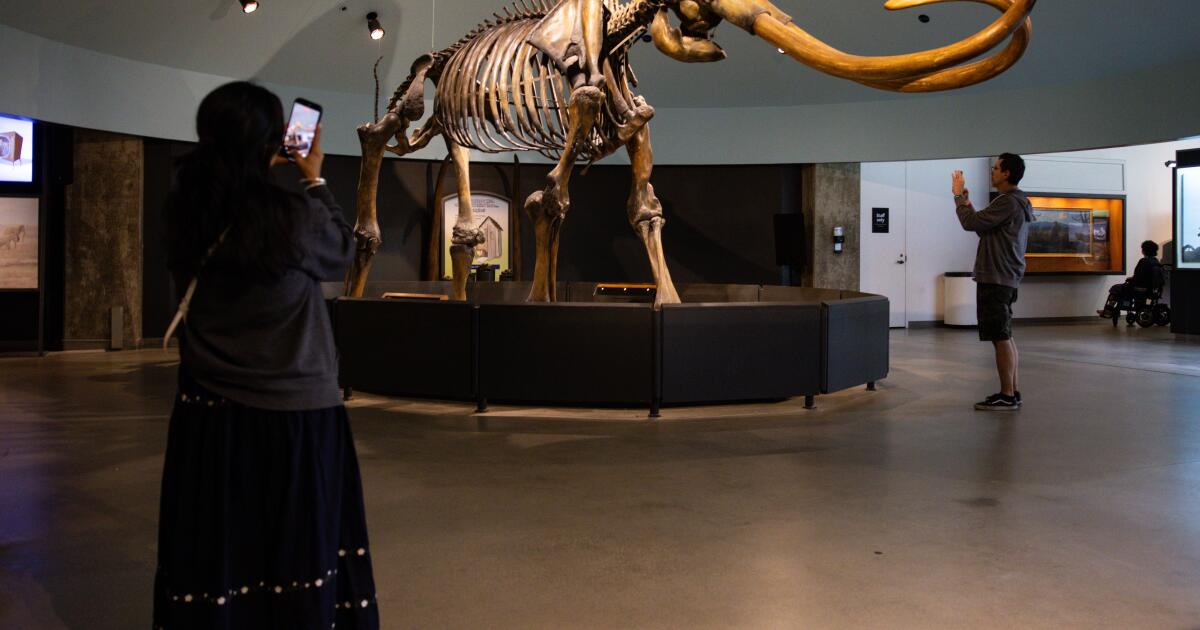
The La Brea Tar Pits in Los Angeles are preparing for a major two-year renovation that will close the museum on July 6 and reopen in summer 2028 as the centerpiece of the Samuel Oschin Global Center for Ice Age Research. Before the shutdown, staff and volunteers are carefully packing up the institution’s 3.5 million fossils, moving bones, skulls, ribs and other fragile specimens into custom foam shells and crates for storage at other Natural History Museums of Los Angeles County properties.
The project will largely keep the museum’s current footprint but is designed to better present the collection and explain the scientific importance of the tar pits, which preserve an unmatched record of late Pleistocene life in what is now Los Angeles. Natural petroleum began seeping to the surface around 60,000 years ago, trapping plants and animals for tens of thousands of years and creating a rare near-complete archive of ancient ecosystem activity. Researchers say no other city has anything comparable.
/https://i.s3.glbimg.com/v1/AUTH_da025474c0c44edd99332dddb09cabe8/internal_photos/bs/2026/m/o/INqGPrQUqPsaWMBbiWtA/arte-2026-06-05t081947.067.png "Former Real Madrid President Reveals Desire to Bring Messi and Cristiano Ronaldo Together at the Club: “It Would Have Been Fantastic”")

Scientists and museum leaders describe the site as especially relevant today because it offers lessons about climate change, extinction, fire and the relationship between humans and the natural world. Past studies using the collection have linked Ice Age biodiversity loss to human arrival and wildfire. Museum officials say that story is central not only to understanding Los Angeles history, but also to understanding environmental pressures facing the modern world.
The current George C. Page Museum, which opened in 1977, no longer reflects what scientists know about the tar pits. Some exhibits still present outdated ideas, including the impression that animals sank like they were trapped in quicksand. In reality, the sticky asphalt only needed to immobilize animals, which could then die from exposure or become prey for other trapped predators. Other displays, especially those about insects and plants, are also considered outdated and will be revised in the new museum.
Museum planners surveyed local residents and visitors about what should remain. Popular features such as the sloping grassy hills outside, the tar-pull interactives and the outdoor mammoth sculptures will stay, though the landscape will be adjusted to reflect current science. The redesigned building will create more room for exhibits, storage, research and education, while replacing the courtyard’s modern greenery with plants more appropriate to the Ice Age environment.
Several mounted Ice Age mammal skeletons will return, joined by four new additions: a baby bison, a baby dire wolf, a giant ground sloth made from real fossils, and Zed, the most complete Columbian mammoth ever found. Zed, whose remains have been conserved for nearly 20 years, will be displayed in the position in which he likely died, apparently during combat with another male.
During the closure, fossil excavation and conservation will continue, though under different conditions. The museum is also developing mobile programs for the roughly 34,000 schoolchildren who visit each year. An expanded version of the popular Fish Bowl lab, where visitors watch preparators clean fossils, will be included in the new design.







 "Shiloh Jolie Turns 20: How Her Style Has Evolved Over the Years")