Tadashi Kawamata’s work sits at the meeting point of careful planning and uncertainty. The Japanese-born artist may spend months or even years developing a project through sketches and models, yet the final result is always shaped by variables he cannot fully control, including available materials, weather, the surrounding landscape, and even responses from local residents. That balance between intention and chance made his collaboration with champagne house Ruinart a natural fit.
Kawamata was invited to contribute to Ruinart’s Conversations with Nature program, which was originally expected to result in a single permanent piece at the company’s headquarters in Reims, France. The project ultimately grew into three installations, each reflecting his approach to site-specific work and the way architecture can interact with nature and public space.

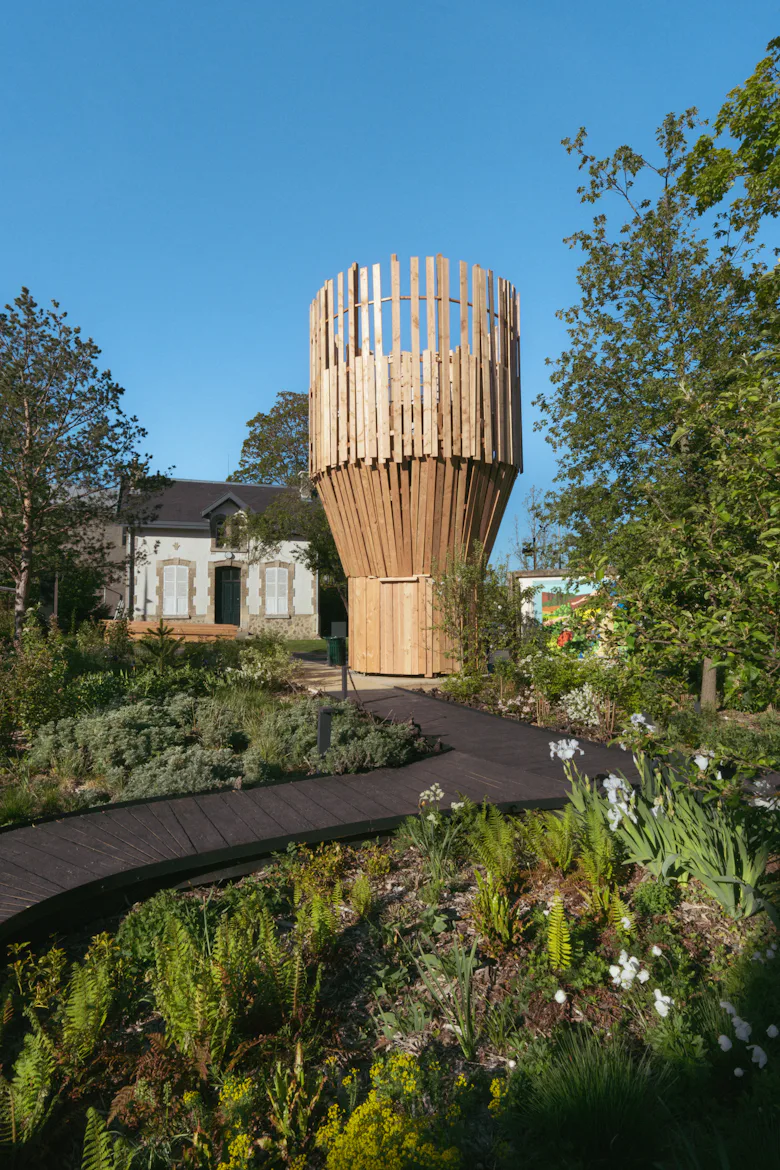
The first work, “Treehub,” is a small birdhouse-like structure positioned among the trees near the headquarters. The second, “Observatory,” rises six meters high and resembles an inverted bottle. From a distance, it functions as a striking sculptural landmark, but once inside, it redirects attention outward toward the garden, the natural surroundings, and the town beyond. The third piece, “Nest,” is attached to the corner of Ruinart’s historic building, extending the dialogue between the site’s architecture and Kawamata’s temporary-like interventions.
Although the original plan was to reuse wood from a previous installation at Paris’s Palais de Tokyo, that exhibition was extended due to its success, forcing Kawamata to source new materials. The change reinforced a central theme in his work: adaptability. He describes his practice as deeply dependent on the conditions of the site, requiring close collaboration with assistants, engineers, architects, and technical specialists. Even environmental factors such as wind must be calculated before construction begins.
Kawamata also embraces impermanence. He says he does not try to make his work perfect or permanent, because he cannot control every variable. Rain, accidents, neighborhood concerns, and other unexpected realities are part of the process. In some places, his projects have faced opposition from residents who objected to the scale or appearance of his structures, showing how public art can provoke as much as it inspires.
The artist also reflected on artificial intelligence and its potential role in creative fields. He described a recent competition in which an AI was used to generate a presentation based on decades of his work. While he noted that the presentation was not the artwork itself, he found the result visually compelling. He suggested that AI might one day continue elements of his practice, especially after he stops working, or after his death. For now, however, Kawamata’s art remains rooted in human labor, direct engagement with place, and the unpredictable nature of building in the real world.