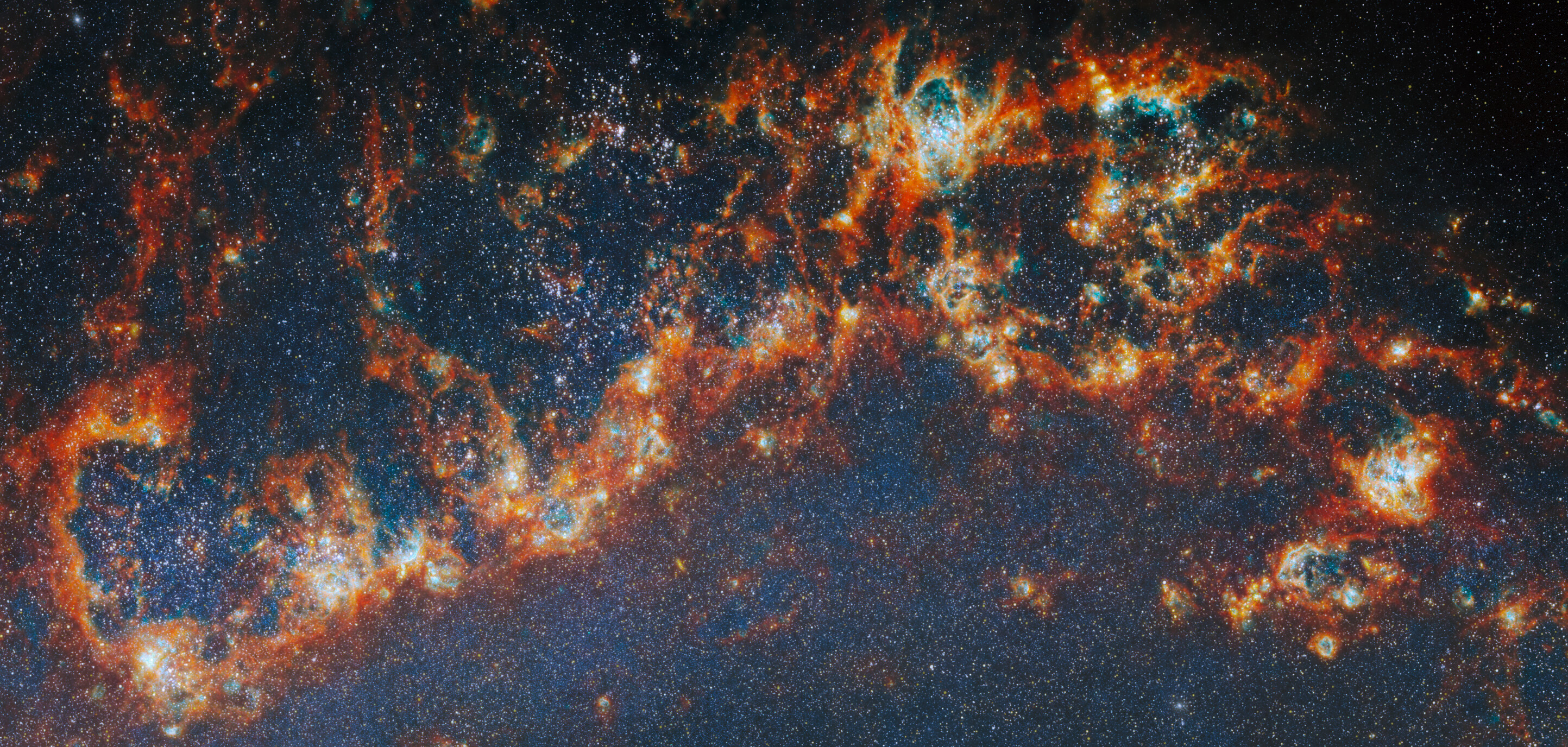
A new near-infrared image released on May 6, 2026, reveals a portion of a spiral arm in Messier 51, also known as the Whirlpool Galaxy. The image is part of a broader scientific effort using NASA’s James Webb Space Telescope to study star formation and the early lives of star clusters in nearby galaxies. M51 is one of four galaxies examined in a survey of nearly 9,000 star clusters, giving astronomers a detailed look at how stellar nurseries develop and evolve.
The study’s findings indicate that the most massive star clusters clear out of the gas and dust clouds that form them more quickly than smaller clusters do. This process matters because the cloud environment affects how stars are born, how clusters grow, and how long they remain hidden from view. By tracking these changes in infrared light, researchers can see deeper into dusty regions where new stars are forming and better understand the sequence of events that shapes a galaxy’s stellar population.


Star formation is a fundamental part of galactic evolution. The way stars and clusters form influences the structure, motion, and long-term development of galaxies. It also helps explain how the conditions for planet formation arise. Since planets form in the disks around young stars, learning how star clusters emerge from dense clouds can provide clues about where and when planetary systems may eventually take shape.
Messier 51 has long been a favorite target for astronomers because of its clear spiral structure and its relative proximity to Earth. Observations of this galaxy help scientists compare star formation in different galactic environments and identify patterns that may apply more broadly across the universe. By examining multiple nearby galaxies rather than a single target, the Webb study offers a wider view of how cluster properties and local conditions affect the pace of star formation.
The image and accompanying data reflect the power of the James Webb Space Telescope to probe dusty, complex regions with high sensitivity and resolution. Near-infrared observations are especially useful for studying star-forming regions because they can penetrate obscuring material that blocks visible light. This allows astronomers to detect young clusters at stages that were previously difficult to measure in detail.
Together, the image and study results advance understanding of how star clusters form, evolve, and disperse their natal material. The work adds an important piece to the puzzle of how galaxies build their stars over time and how the environments around young stars may eventually lead to planet formation.