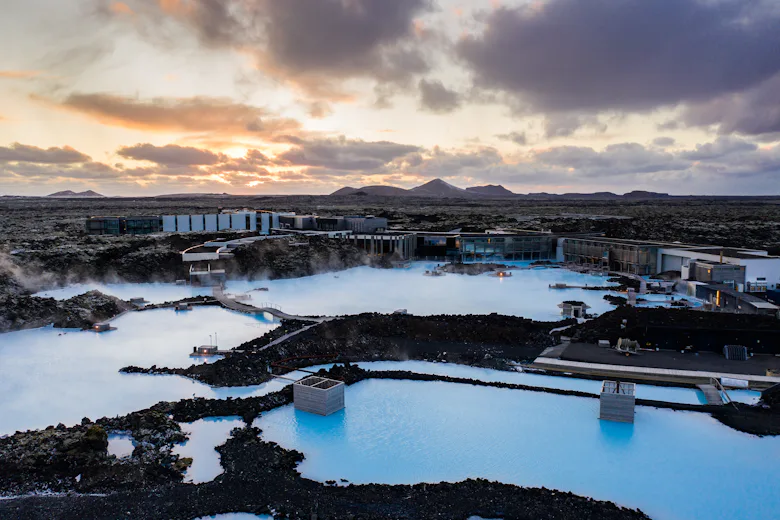
Luxury skincare brands are increasingly drawing on hyper-local natural ingredients sourced from distinctive environments such as Icelandic geothermal pools, Hungarian mineral lakes, Azorean volcanic soil and Sicilian regenerative farms. The appeal lies not only in the story and imagery of these ingredients, but also in their potential biological effects on the skin. Blue Lagoon Skincare, for example, is built around research on Iceland’s Blue Lagoon, where silica, salinity, heat and a rare microalgae create conditions that researchers say can support collagen production and strengthen the skin barrier. That science led to the development of BL+ Complex, a patented bioactive that is now central to the brand’s creams, serums and masks.
Other beauty labels are following a similar model. Omorovicza sources mineral-rich water and black mud from Lake Hévíz in Hungary, while Clark’s Botanicals has introduced a serum combining plant cell-derived exosomes, goji berry exosomes and a jasmine-based complex. Dior’s L’Or de Vie line uses grapes from Château d’Yquem, which the house says help fight oxidative stress. In the Azores, biotech company Ignae works with camellia extracts and other plants grown in volcanic soil, arguing that environmental stress helps these ingredients develop stronger antioxidant properties. Founder Miguel Pombo says the brand’s local flora has been shaped by winds, ash and mineral-rich terrain over centuries.

The article also highlights a broader debate in beauty: whether the power of these niche ingredients comes from measurable efficacy or from marketing. Some founders and scientists argue that the science is real and increasingly testable. Lia Chavez, who created Hildegaard Haute Botanical Oils, grows and harvests many of her own botanical extracts and says plant intelligence and soil biology matter for skin performance. Her formulations include American ginseng, lemon balm and damask rose sourced from specific high-altitude regions, with an emphasis on mineral balance and bioavailability.
Irene Forte, who built her skincare line from ingredients tied to her family’s Sicilian farmland, takes a similar view. Her products use olive oil and other Mediterranean-derived ingredients rich in omega fatty acids, vitamin E and polyphenols. She also works with hibiscus seeds to create a neuropeptide that she says helps relax facial muscles, describing it as “nature’s Botox.” Still, she emphasizes that nature alone is not enough and that scientific formulation is essential to unlock the full value of raw ingredients.
Experts quoted in the story acknowledge that skincare remains a largely unregulated and highly promotional field, but they also point to a growing body of research that seeks to measure results more rigorously. Blue Lagoon researchers, for instance, are preparing a peer-reviewed paper on a microalgae extract they say can neutralize a major aging-related protein. Across the sector, the central idea is the same: luxury skincare is increasingly merging place-based ingredients, biotechnology and clinical research to transform rare natural resources into products promising visible and measurable benefits.